 Business License

Application of KT148A Voice Chip in Smart Infusion Monitoring Systems
In modern medical environments, infusion therapy is a common treatment method. However, traditional infusion monitoring primarily relies on medical staff's regular rounds or family members' watch, which is not only inefficient but also poses safety risks. In recent years, with the development of IoT and smart hardware technologies, smart infusion monitoring systems have emerged. These systems typically use sensors to monitor infusion progress in real-time and provide alerts when intervention is needed.

Traditional infusion alarms mostly use buzzers to emit simple alerts. While they serve a reminder function, the amount of information they convey is limited and cannot clearly express specific situations. The introduction of the KT148A voice chip has completely changed this landscape—it replaces monotonous beeps with clear, informative voice prompts, significantly improving user experience and safety.
Technical Analysis of KT148A Voice ChipBasic Chip CharacteristicsKT148A is a 32-bit DSP voice chip in a standard SOP8 package with the following outstanding features:
Large built-in storage: 420KByte voice storage space, supporting up to 420 seconds of voice duration
High-quality output: 16-bit PWM output, can directly drive 8 ohm/0.5W speakers
Flexible control: Supports one-wire serial port control, up to 224 voice addresses
Low power design: Standby power consumption less than 25μA, ultra-low power mode only 1.7μA
User programmable: Users can replace voice content themselves via serial port without special programming tools
 Communication Protocol Advantages
KT148A uses a one-wire serial communication protocol, requiring only a single data line to achieve complete control functions:
6ms start signal + 8-bit data format
Pulse width encoding (200us:600us represents 1, 600us:200us represents 0)
Supports multiple functions such as volume adjustment, combination playback, and loop playback
The smart infusion monitoring system consists of the following core components:
Drip sensor: Monitors infusion speed and working status in real time
Main controller: Processes sensor data and makes judgments
KT148A voice module: Receives instructions and plays corresponding voice prompts
Wireless communication module (optional): Sends alarm information to the nurse station

Based on KT148A's multi-voice segment characteristics, we designed rich voice prompts for the infusion monitoring system:
// Voice address definition #define VOICE_MEDICINE_EMPTY 0x01 // "Medicine used up, please add in time" #define VOICE_ADDITIVE_EMPTY 0x02 // "Additive used up, please add in time" #define VOICE_QUALITY_CHECKED 0x03 // "Quality inspection completed, start dispensing" #define VOICE_STOP_MEDICINE 0x04 // "Turn off dispensing machine" #define VOICE_FLOW_TOO_FAST 0x05 // "Flow rate too fast, please adjust" #define VOICE_FLOW_TOO_SLOW 0x06 // "Flow rate too slow, please check" #define VOICE_NEARLY_EMPTY 0x07 // "Infusion nearly completed" #define VOICE_BUBBLE_DETECTED 0x08 // "Bubble detected, please handle" // Combination playback example: First play near-completion prompt, then play specific operation guide void play_nearly_empty_warning(void) { oneline_send_one_data(0xF3); // Combination playback instruction udelay(20000); oneline_send_one_data(VOICE_NEARLY_EMPTY); udelay(20000); oneline_send_one_data(VOICE_PREPARE_CHANGE); }Hardware Connection DesignKT148A's connection with the main controller is extremely simple:
Main controller IO ----[1K resistor]---- KT148A PIN3(ONELINE)
Main controller IO ----[10K pull-up]--- KT148A PIN2(BUSY)
Speaker positive ---- KT148A PIN5(SPK1)
Speaker negative ---- KT148A PIN6(SPK2)
Considering the high requirements of medical devices for battery life, we fully utilize KT148A's low-power characteristics:
// Enter ultra-low power mode when system is idle void enter_ultra_low_power(void) { oneline_send_one_data(0xF0); // Enter ultra-low power mode (1.7μA) } // Wake up chip void wake_up_chip(void) { IO1_LOW(); // Pull data line low for 10ms to wake up chip udelay(10000); IO1_HIGH(); // Release data line udelay(30000); // Wait for chip initialization }Practical Application Effects and ValueUser Experience ImprovementClear information delivery: Compared to traditional buzzers, voice prompts can clearly express problem types and solutions
Multi-language support: Can record different language versions according to regional needs
Adjustable volume: 15-level volume adjustment to adapt to different environmental needs
Timely warning: Abnormal droplets, infusion completion and other situations can get timely reminders
Reduce human error: Clear voice instructions reduce the probability of operation errors
Reduce medical pressure: Automated prompts reduce the burden of medical staff rounds
Hardware cost: KT148A chip itself is low cost, SOP8 package saves PCB space
Development cost: One-wire serial control greatly simplifies software development difficulty
Maintenance cost: Voice content can be updated via serial port at any time without replacing hardware
Sampling rate selection: Recommended to use 16KHz sampling rate, balancing sound quality and storage space
File optimization: Remove silent parts at the beginning and end of audio to reduce unnecessary storage occupation
Format conversion: Use official tools to convert WAV/MP3 to F1A format
Lithium battery power supply: Directly connect to PIN8(VBAT), PIN7(VDDIO) needs to be connected to 104 capacitor to ground
Dry battery power supply: When voltage is lower than 3.6V, short PIN7 and PIN8
Filter capacitor: The power input must add sufficient capacity filter capacitor

Download mode entry: Pull PIN5 low during power-on to enter voice download mode
Insufficient volume: Check whether the power supply voltage is sufficient, higher voltage can provide greater output power
Communication failure: Use logic analyzer to check whether the one-wire serial timing meets requirements
The application of KT148A voice chip in smart infusion monitoring systems fully demonstrates its advantages as a low-cost, high-performance voice solution. By upgrading simple beep alarms to rich voice prompts, it not only improves the product's user experience but more importantly enhances medical safety and reliability.
With the continuous development of medical device intelligence, voice chips like KT148A that are easy to integrate and feature-rich will play important roles in more medical scenarios, contributing technical strength to the digital transformation of the medical industry.
Developers interested in KT148A voice chip are welcome to contact us for complete technical information and development support.
Note: The medical device applications involved in this article need to comply with relevant medical device regulations. Corresponding certification and compliance should be noted in actual product development.
Recently Posted
-
The KT148A Chip Gives Robot Vacuums a Voice for Worry-Free Whole-Home Cleaning
November 30, 2025In recent years, as living standards improve and work pressure increases, more and more households have begun relying on smart app Read More
 -
Understanding BLE (Bluetooth Low Energy) vs. Classic Bluetooth: A Comprehensive Guide
September 16, 2025Bluetooth technology has evolved significantly, powering a wide range of devices from wireless headphones to smart home gadgets. T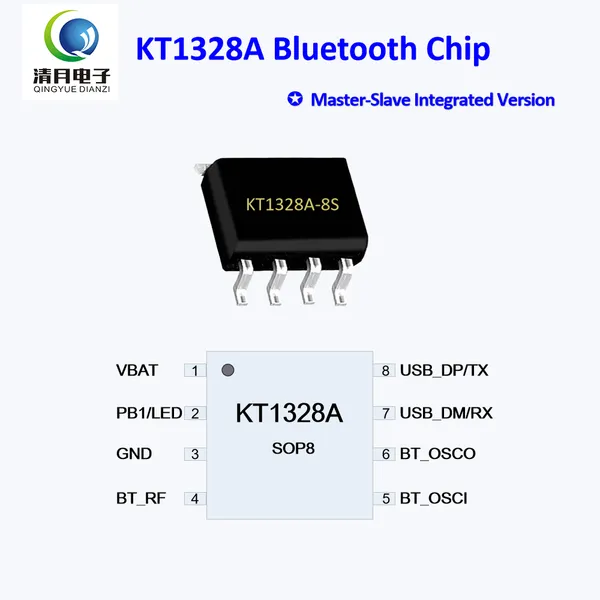 Read More
 -
KT142A - 16S MP3 Decoding Chip: Unleashing a New Intelligent Experience for Children's Electric Toot
September 16, 2025"Brushing teeth is like a battle!" This is the helpless feeling of many parents. Surveys show that over 70% of children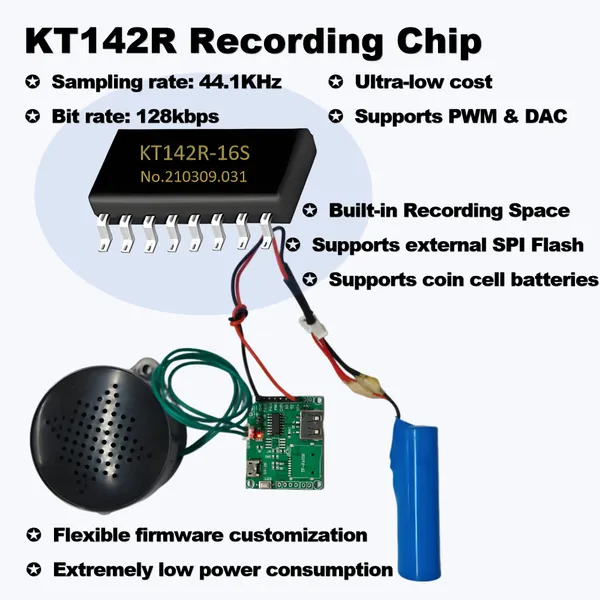 Read More
 -
Introduction to AC6951C Bluetooth Transmitter and Receiver Module
September 9, 2025I. Product Picture II. Peripheral Function DescriptionThe following is the functional description corresponding to each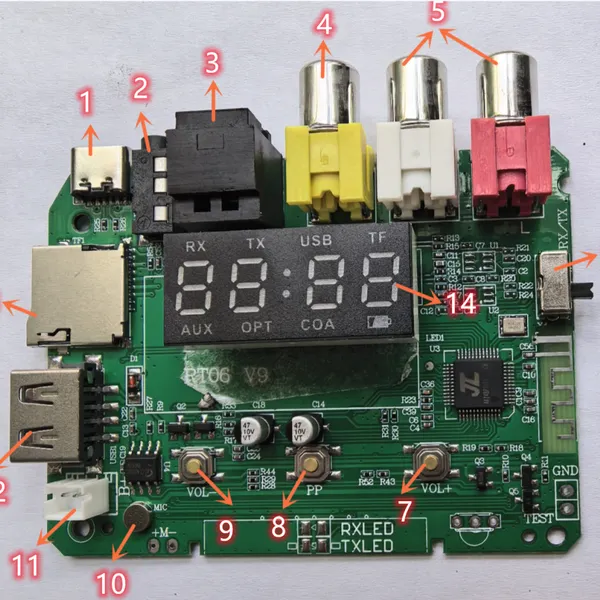 Read More

Contact Us
Recommended Products
-
 JL Jieli Bluetooth Chip AC6955F4 Stereo Lossless Audio Bluetooth MP3 Decoder Board USB TF Card Player AUX IN/OUT SW IR ControlUS$ 1MOQ: 1 Piece
 -
JL AC6966B AC6965E AC6969D Development Board Kit Open Source SDK Schematic Debug Tool Core Board AC696 Bluetooth SoC Evaluation Test Board for SpeakerUS$ 30MOQ: 1 Piece
-
JL AC6951C LQFP48 32-bit DSP Bluetooth V6.0 Audio Chip 240MHz FPU DAC ADC Encoder Decoder For Bluetooth Speaker Soundbar TWS Speaker Alarm Clock AudioUS$ 1MOQ: 1 Piece
-
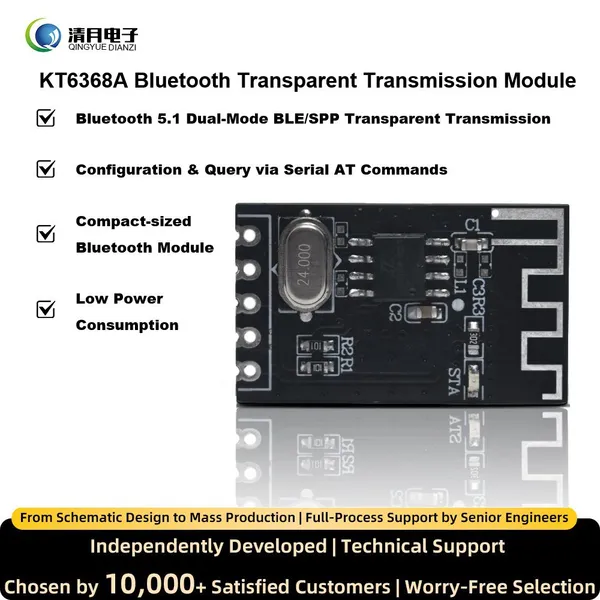
KT6368A Bluetooth Module Support 5.1 BLE/2.1 SPP Transparent Transmission Pure Data IC UART AT Controller For Arduino or ESP32US$ 1MOQ: 1 Piece
-
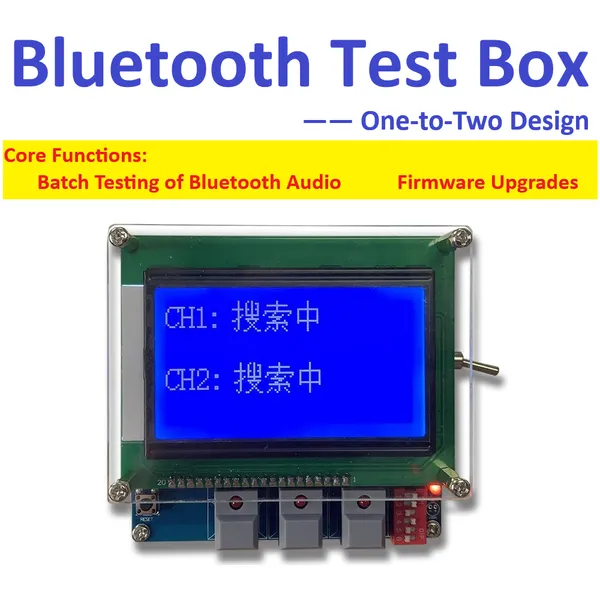
JL Bluetooth Test Box AC692N/AC695N/AC696N Compatible Full Series One-to-Two Testing Batch Upgrade for JieLi Audio Bluetooth Chip Test 9V Power SupplyUS$ 80MOQ: 1 Piece
-
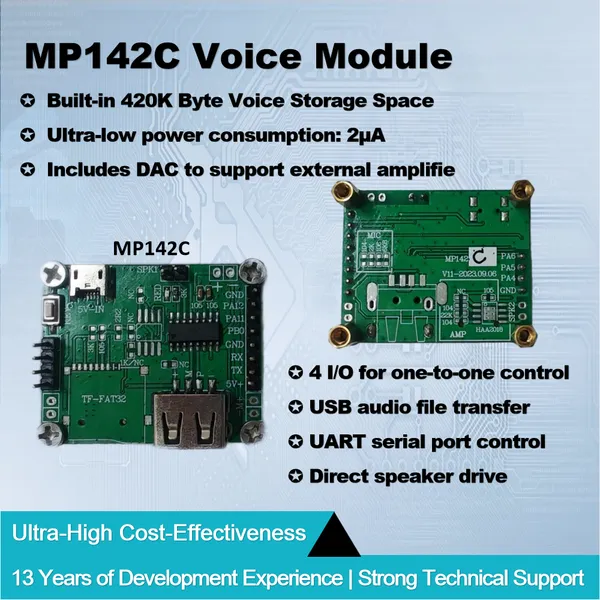
Voice Module MP142C 320KB Built-in Space 4 IO TTL or Serial Port Control PWM Directly Drive Speaker or DAC External Power Amplifier MP3 Sound PlaybackUS$ 2.5MOQ: 1 Piece
-
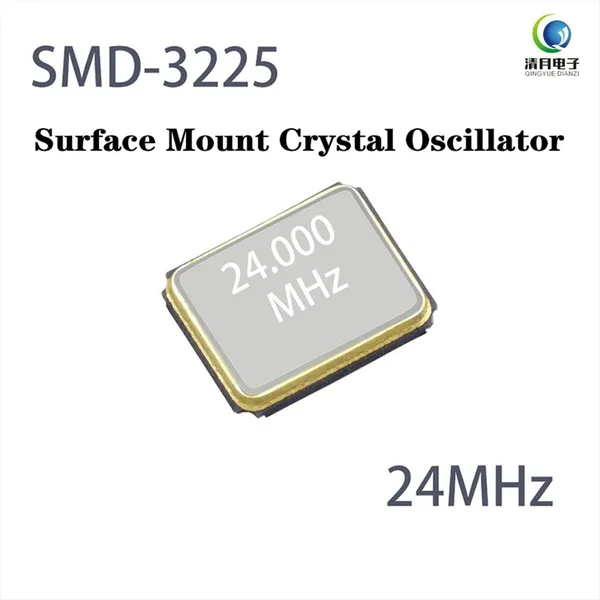
3225 SMD Crystal Oscillator 24.000MHz 12pF 10ppm Matched for JieLi Bluetooth Chip IC JL Bluetooth Audio Module Wireless Device DIY Electronic SMT 4PINUS$ 1MOQ: 1 Piece
-
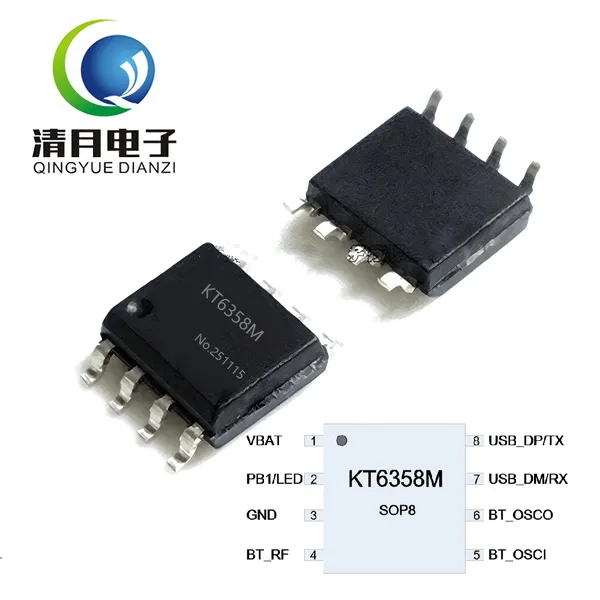
KT6358M BLE Master Bluetooth Chip IC Auto Connect Slave Module Support AT Command UART Control by STM32MCU ESP32 Arduino SOP8 Transparent TransmissionUS$ 1MOQ: 1 Piece
-
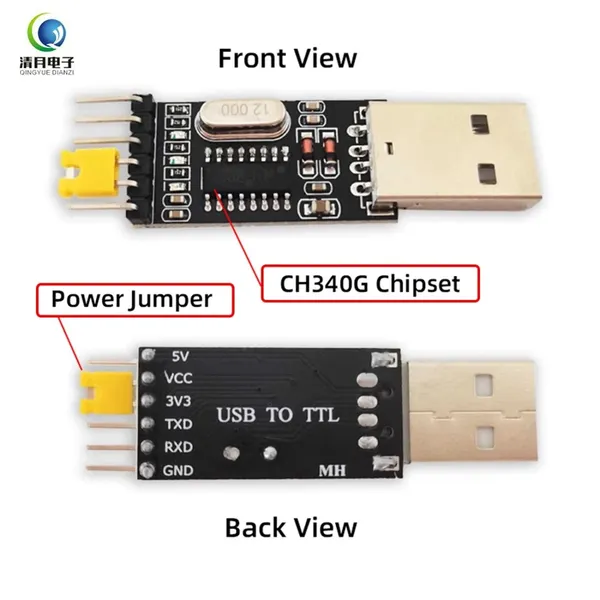
USB to TTL CH340G Flash Memory Board Module 3.3V/5V Universal UART Debugging Tool for MCU Arduino Nano Mini Pro ESP32 ESP8266 STC STM32 Raspberry PiUS$ 2MOQ: 1 Piece
-
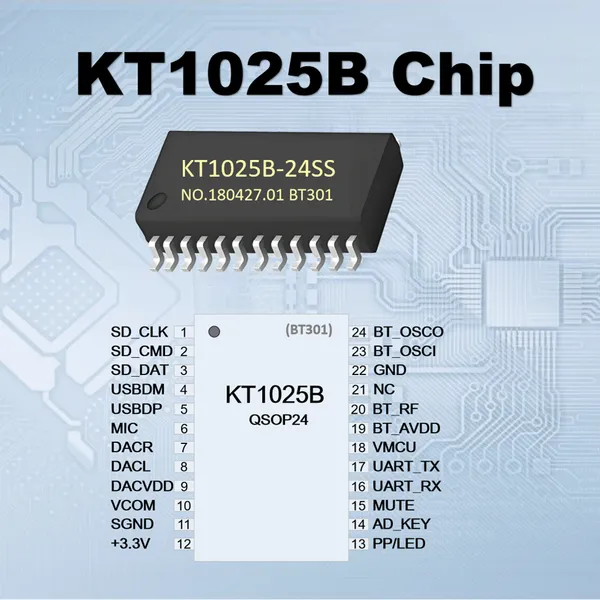
KT1025B BT301 Bluetooth 5.0 Audio Chip Support U-Disk TF Card SPIFLASH MP3 Decoder BLE SPP UART AT Command Control For Speaker DIY for Audio ReceiverUS$ 1MOQ: 1 Piece
-
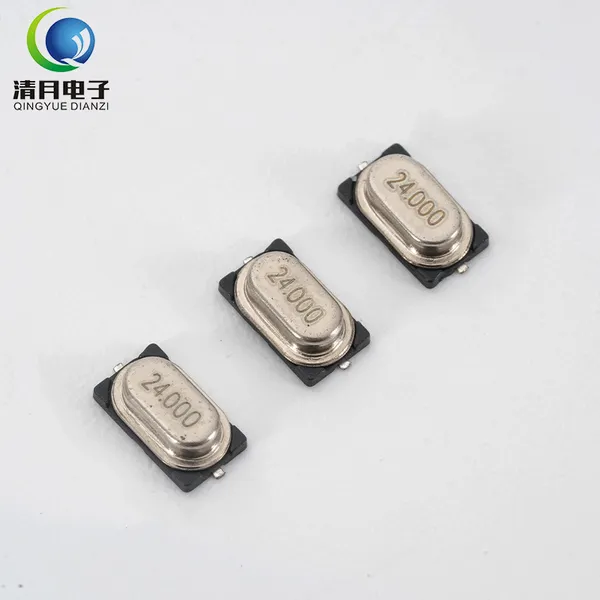
M49S Crystal Oscillator SMD Package Surface Mount 24.000MHz 12pF 10ppm High-Precision Mini 2PIN for JieLi Bluetooth Audio Chip JL IC Automotive GradeUS$ 1MOQ: 1 Piece
-
MP142A Voice Module Built-in MP3 Audio Flash Memory External Flash TF Card USB Disk Sound Playback UART AT Control PWM Drive Speaker or DAC AmplifierUS$ 4MOQ: 1 Piece
-
BT401 Dual-Mode Bluetooth Module 5.0 With Built-in Prompt Sound External SPI Flash TF Card USB Audio BLE Data Transmission UART AT Command ControlUS$ 1MOQ: 1 Piece
-
KT6368A Bluetooth HID Dual-Mode BLE and SPP Version Module for Bluetooth Keyboard/Mouse Remote Controller and Selfie Shooter With AT Commands via UARTUS$ 1MOQ: 1 Piece
-
KT1328A Bluetooth Chip Master-Slave Integrated Ver JieLi IC BLE Passthrough Serial Port AT Command Control by Arduino Nano SOP8 for Remote-controlledUS$ 1MOQ: 1 Piece
-
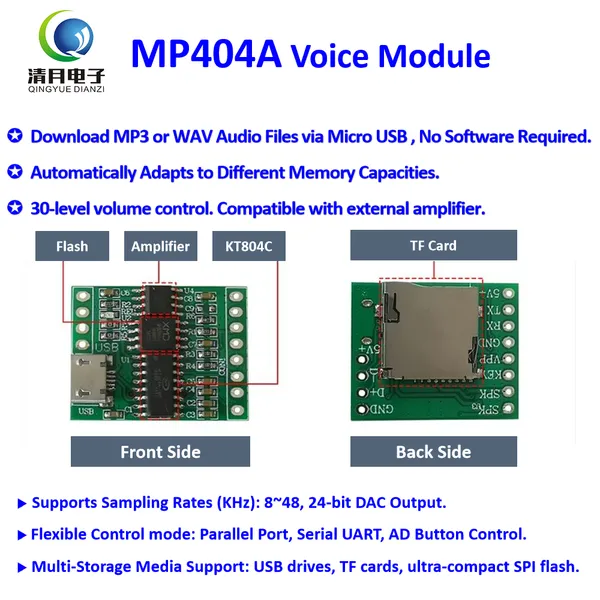
MP404A Micro USB Downloadable MP3/WAV Music Board Play Voice Module Sound Box for Plush Toys Christmas Birthday Creative Greeting Cards DIY Xmas GiftsUS$ 2MOQ: 1 Piece
-
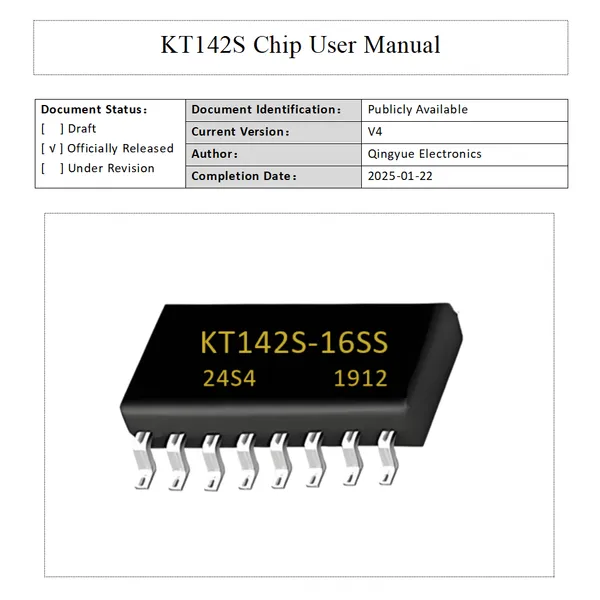
KT142S Voice Chip MP3 Player Module 3 Trigger I/O USB Update 0.5W Speaker Support DAC Output Sound IC for DIY Electronics Gift Christmas Jewel CaseUS$ 1MOQ: 1 Piece
-
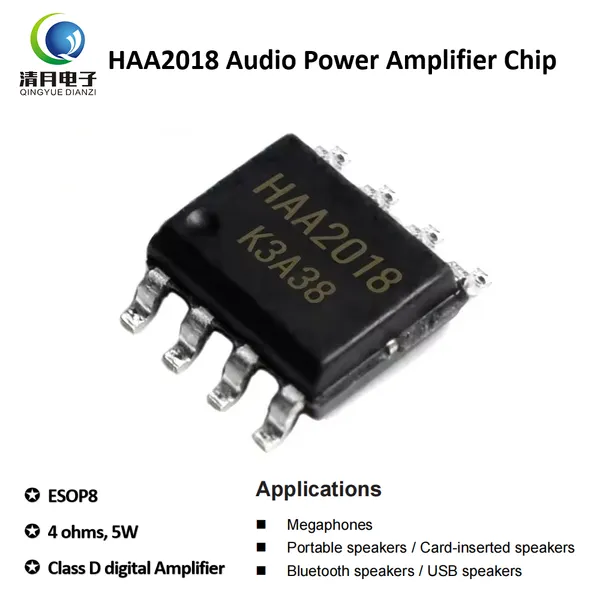
10pcs HAA2018 Amplifier IC Small Speaker 4 Ohms 5W Audio Power Amplifier Chip SOP8 Voice Amplifier Circuit Replaces to 8002 Chip for Bluetooth SpeakerUS$ 1MOQ: 1 Piece
-
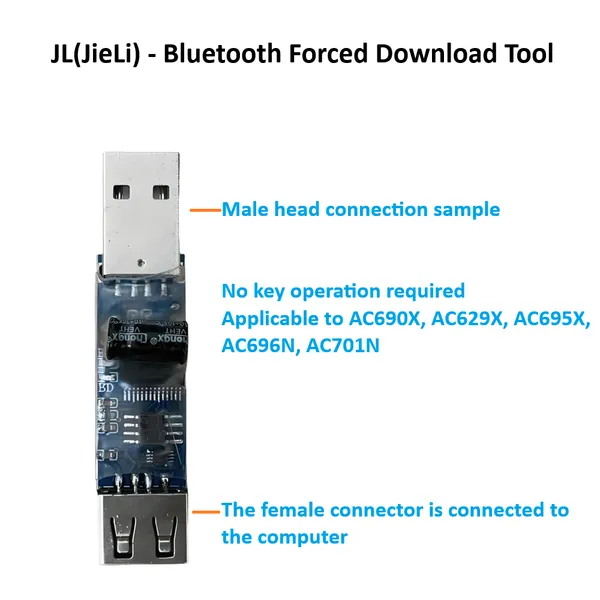
JL Chips Forced Download Tools 4.0 Updater Full Series JieLi Bluetooth Chips Programmer MCU Development IC Burner USB Serial Port Debug Upgrade DongleUS$ 8MOQ: 1 Piece
-
KT6328A Bluetooth Chip BLE 5.1 Passthrough 20µA Ultra-low Power Consumption Bluetooth IC AIoT Serial Port Data Communicate AT Command Bluetooth ModuleUS$ 1MOQ: 1 Piece